
The Celebrity Expert: When Fame Replaced Credentials, Who Decided Which Voices Get to Shape What We Believe?
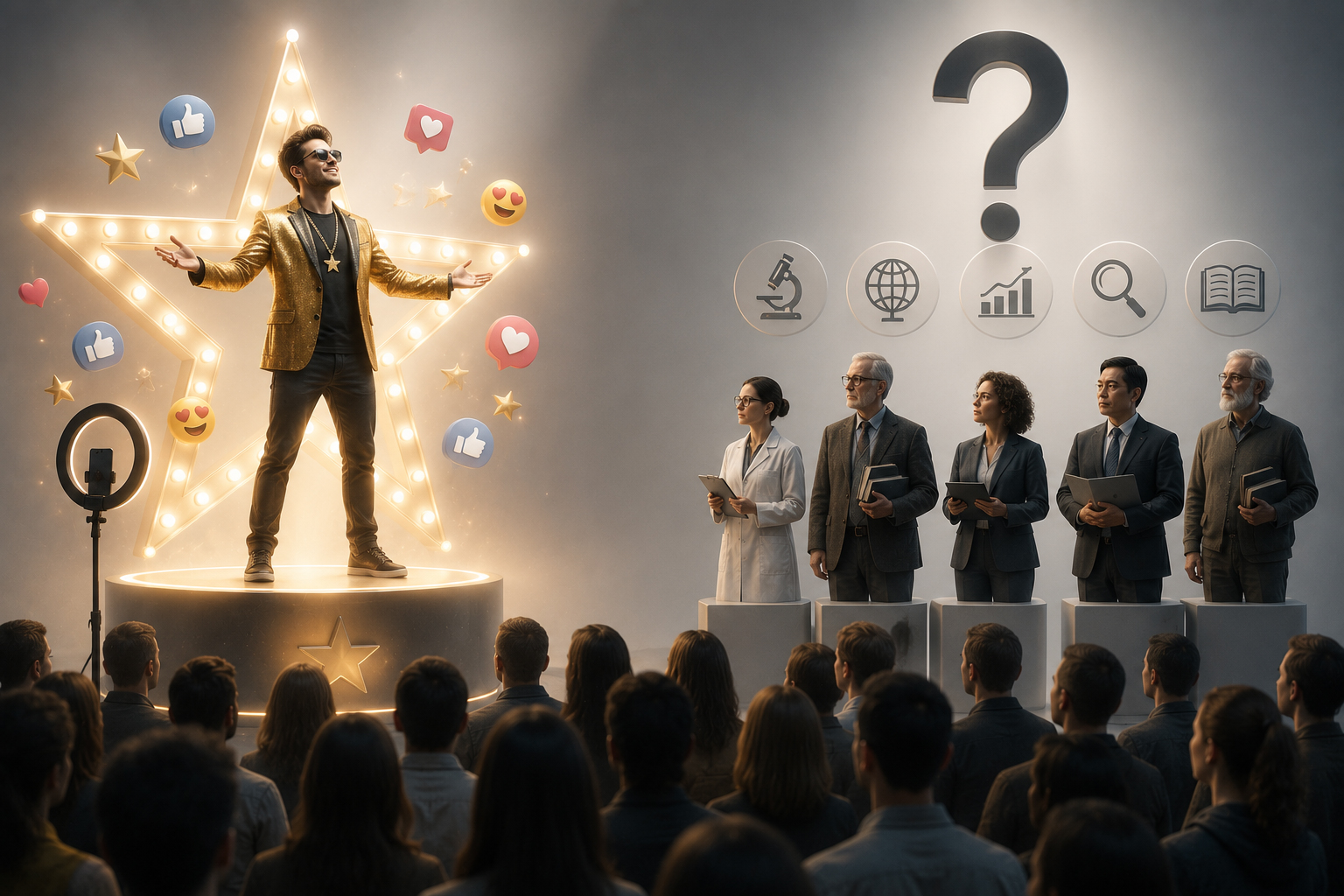
A celebrity can reach millions overnight with a health claim, a climate opinion, or a political take — and often outdraw the credentialed expert saying the opposite. Malcolm Gladwell, Dr. Susan Fiske, and Dr. Neil deGrasse Tyson debate whether the rise of celebrity expertise is democratizing knowledge or quietly replacing accountability with charisma.
Key Metrics
64%
Americans who trust celebrity opinions over experts
82%
People influenced by social media personalities
57%
Individuals who value credentials in specialists
In an era where social media dominates public discourse, a pressing question arises: have we shifted from valuing expert opinions based on credentials and experience to glorifying celebrity status? The intersection of fame and authority is reshaping our belief systems and challenging the credibility of traditional experts.
Context
Social media influencers and celebrity figures can amass significant followings and impact public opinion, often without formal expertise in the subjects they discuss. This inquiry has become increasingly urgent in light of contemporary issues — public health, climate change, and social justice — where misinformation can carry profound implications.
Perspective: Malcolm Gladwell
Malcolm Gladwell, a well-known author and journalist, argues that the landscape of expertise is shifting, but not necessarily for the worse. He views celebrity experts as part of a democratization of knowledge, suggesting that new voices provide diverse perspectives that challenge established norms.
Gladwell emphasizes the importance of storytelling in knowledge transfer, asserting that compelling narratives can convey complex ideas more effectively than traditional academic formats. However, he acknowledges the risk: the emotional resonance of these stories might overshadow the factual rigor that knowledgeable experts bring to the discourse.
Perspective: Dr. Susan Fiske
Dr. Susan Fiske, a psychologist and professor, offers a cautionary stance. She stresses that while charismatic figures can garner attention, their popularity does not equate to validity. Fiske notes that the human brain is wired to pay attention to attractive and prominent individuals, but this bias can distort perceptions of competence.
Fiske posits that the allure of celebrity often distances individuals from critical thinking. When expertise is overshadowed by a persona, it risks reducing complex societal discussions to simplistic narratives. She argues for a reliance on credentialed experts, particularly in fields where evidence and methodological rigor are paramount.
Advertisements
Perspective: Dr. Neil deGrasse Tyson
Dr. Neil deGrasse Tyson, an astrophysicist and science communicator, takes a balanced view. He acknowledges that celebrity can serve as a valuable platform to communicate scientific ideas to broader audiences, inspiring curiosity and promoting understanding in fields often perceived as esoteric.
However, Tyson emphasizes that being charismatic or famous should not exempt individuals from accountability regarding their expertise. He raises concerns about the oversimplification of scientific discourse, pointing out that the complexity of issues like climate change may be lost if discussed only through a celebrity lens. He calls for a partnership between experts and communicators to ensure accurate representation of scientific facts while engaging the public effectively.
Editorial Synthesis
Where Experts Agree
All three experts agree that celebrity figures hold substantial sway over public opinion and can shape narratives significantly. There is consensus on the importance of critical thinking when consuming information from both experts and celebrities. The democratization of knowledge through various platforms has the potential to diversify voices in public discourse.
Where Experts Disagree
Gladwell views celebrity influence positively, while Fiske warns against it, stressing that popularity doesn't equate to competence. Tyson finds a middle ground, recognizing potential benefits yet advocating for accountability. Gladwell also emphasizes storytelling's role in expertise, while Fiske cautions that narrative-driven approaches may obscure factual understanding.
Why This Matters
In a time when misinformation proliferates, distinguishing between credible expertise and influential celebrity becomes crucial for public decision-making. As the lines between fame and credibility blur, society must prioritize informed voices based on knowledge, experience, and accountability.
The future may depend on whether a culture of expertise can thrive alongside the allure of celebrity — ensuring that the public remains equipped to make informed choices in health, policy, and beyond.


Editorial Take
Navigating the Balance Between Credibility and Charisma
Cautiously OptimisticWhile celebrity experts can broaden the dialogue, we must prioritize established expertise to safeguard the truth.
In today's digital age, the rise of celebrity experts presents a dual-edged sword. On one hand, celebrities can democratize knowledge and make complex issues more relatable through storytelling, as Malcolm Gladwell suggests. On the other, the allure of charisma and emotion might overshadow the solid, evidence-based insights that true experts provide, a concern raised by Dr. Susan Fiske. As consumers of information, we must strive to navigate this landscape with discernment, seeking a balance where diverse voices enrich discourse without compromising on the integrity and rigor that expert knowledge offers. It is imperative to cultivate critical thinking skills that enable us to differentiate between valuable insights and mere entertainment, ensuring that we do not sacrifice credibility at the altar of celebrity.
What do you think?
Cast your vote on this debate.
References
Continue the Debate
Related topics emerging from this analysis:
The Illusion of Expertise: Are Celebrity Influencers Undermining Scientific Authority?
Explores how the rise of celebrity influencers may dilute the authority of scientific experts and the implications for public trust in expert opinion.
Narrative vs. Data: Can Storytelling Replace Empirical Evidence in Public Discourse?
Investigates the role of storytelling in shaping public beliefs and whether compelling narratives can hold as much weight as empirical data in discussions on critical issues.
Social Media Algorithms: Who Decides Which Voices Are Amplified?
Examines the role of social media algorithms in determining which experts and celebrities gain visibility, influencing public perceptions and beliefs.
The New Gatekeepers: How Influencers Are Redefining Credibility
Analyzes the emergence of influencers as new gatekeepers of information and the criteria by which they claim credibility in comparison to traditional experts.