
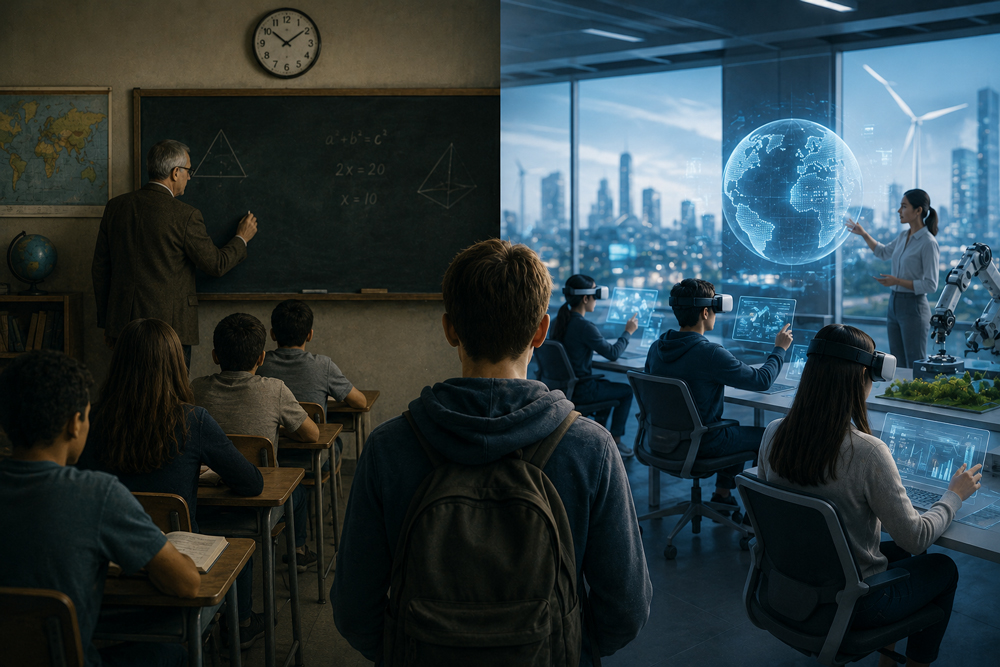
The Future of Education: Are Schools Preparing Students for the World, or for a World That No Longer Exists?
As classrooms cling to 20th-century models, experts debate whether traditional education is equipping the next generation — or leaving them behind.
Key Metrics
85 million
Jobs displaced by 2025 due to shifts in labor dynamics
97 million
New roles expected to emerge by 2025
73%
Percentage of educators who believe major changes are needed in education
Context: Why It Matters Now
As the landscape of both employment and society has drastically changed due to globalization and technological innovation, the relevance of traditional educational methods is being scrutinized. The World Economic Forum's Future of Jobs Report states that by 2025, 85 million jobs may be displaced by the shift in labor between humans and machines, while 97 million new roles may emerge that are more aligned with the new division of labor. This dynamic underscores the pressing need for educational institutions to reassess their methodologies and curricula.
Expert Perspectives
Perspective: Sir Ken Robinson
Sir Ken Robinson, a longstanding advocate for reform in education, argues that the current systems are fundamentally flawed. He emphasizes that schools are largely designed around an industrial model of learning, which prioritizes standardized testing over creativity and critical thinking. Robinson posits that this approach not only alienates students but also fails to equip them with the skills necessary for success in a world where innovation is paramount.
"We don't grow into creativity; we grow out of it. Or rather, we get educated out of it."
Robinson suggests that the emphasis on standardization diminishes the diverse talents of students. He urges for an education system that nurtures individual passions and skills, arguing that the workforce of the future will require adaptable thinkers who can tackle complex, unpredictable challenges.
Perspective: Sal Khan
In contrast, Sal Khan, the founder of Khan Academy, advocates for a more personalized approach to education through technology. He highlights how online learning platforms can cater to individual student needs, allowing for mastery of concepts at their own pace. Khan argues that while schools may still operate under outdated frameworks, the integration of technology can revolutionize the way knowledge is delivered and acquired.
Advertisements
"If you focus on mastering the material, then you can go as fast as you want."
Khan emphasizes the importance of providing students with the right tools to learn effectively and efficiently. He believes that modern education should prepare students for a world where continuous learning is essential, aligning with the needs of an ever-changing economic landscape.
Perspective: Angela Duckworth
Angela Duckworth, a psychologist and author known for her research on grit, brings a different perspective to the conversation. She emphasizes that beyond knowledge, certain character traits play a crucial role in success. Duckworth argues that schools should not only focus on academic achievement but also cultivate resilience and perseverance in students.
"Enthusiasm is common. Endurance is rare."
Duckworth illustrates that cultivating grit can help students navigate an uncertain future. In her view, educational frameworks that encourage persistence — regardless of the subject matter — are essential for preparing students for a future fraught with challenges. She sees the need for schools to develop curricula that incorporate character education alongside traditional learning.
Editorial Synthesis
Where Experts Agree
- Need for Change: All three experts recognize that the current educational systems are not adequately preparing students for future demands.
- Importance of Skills: There is consensus on the need for educational approaches that prioritize critical thinking, creativity, and adaptability.
- Role of Technology: They acknowledge that technology can play a pivotal role in transforming learning experiences.
Where Experts Disagree
- Approach to Learning: Robinson advocates for a complete overhaul of the educational framework, while Khan promotes modifying existing structures with technology.
- Focus of Education: Robinson emphasizes creativity and passion; Khan focuses on mastery learning; Duckworth stresses the development of character traits like grit.
- Outcome Measurement: The experts diverge on how success in education should be measured — Robinson favors innovative thinking, Khan prioritizes skill mastery, and Duckworth advocates for perseverance.
Why This Matters
As the debate surrounding the future of education intensifies, the need for an evolved system that addresses both knowledge acquisition and character development becomes apparent. With emerging industries rapidly redefining expectations for a workforce, educational institutions must grapple with their roles as both information providers and cultivators of essential life skills. The potential consequences of inaction are substantial: a generation of students may graduate unprepared to meet the challenges that await them.
The insights from experts like Sir Ken Robinson, Sal Khan, and Angela Duckworth buttress the argument that schools must evolve rather than cling to antiquated models. Prioritizing adaptability in methods, curricula, and student assessment will not only empower students but also contribute to a society that thrives on innovation and resilience. Ultimately, addressing these educational shortcomings is not just about academic success; it is about preparing future generations to contribute meaningfully to a world that is in constant flux.


Editorial Take
Rethinking the Future of Education
Urgently Needed ReformEducation must evolve to meet the demands of an ever-changing world.
As we stand at the crossroads of educational reform, it is imperative that we acknowledge the urgent need for a paradigm shift in how we educate our students. Traditional methods, rooted in the industrial age, are increasingly inadequate for preparing learners for a future defined by rapid change and technological integration. Educators, policymakers, and stakeholders must come together to foster an environment that prioritizes creativity, critical thinking, and individual skill development. By shifting the focus from standardized testing to personalized and adaptive learning pathways, we can cultivate a generation of innovators and adaptable thinkers capable of thriving in an unpredictable workforce. Embracing a more holistic educational model will not only benefit students but also society at large, as we prepare for a world in need of fresh ideas and diverse talents.
What do you think?
Cast your vote on this debate.
Continue the Debate
Related topics emerging from this analysis:
Embracing Technology in Classrooms: The Role of AI in Education
Exploring how artificial intelligence and technology can be integrated into educational methodologies to better prepare students for future job markets.
The Importance of Emotional Intelligence in Modern Education
Discussing how developing emotional intelligence alongside academic skills is crucial for student success in an evolving work environment.
Global Perspectives: How Different Countries Are Reforming Education
Examining educational reforms in various countries that are adapting to technological and social changes, highlighting successful strategies.
Mindfulness and Mental Health: Preparing Students for Tomorrow's Challenges
Investigating the role of mental health and mindfulness practices in schools as a vital component for equipping students with resilience for future uncertainties.