
The Paradox of Progress: Why Does Every Solution We Invent Seem to Generate a Problem We Weren't Ready For?
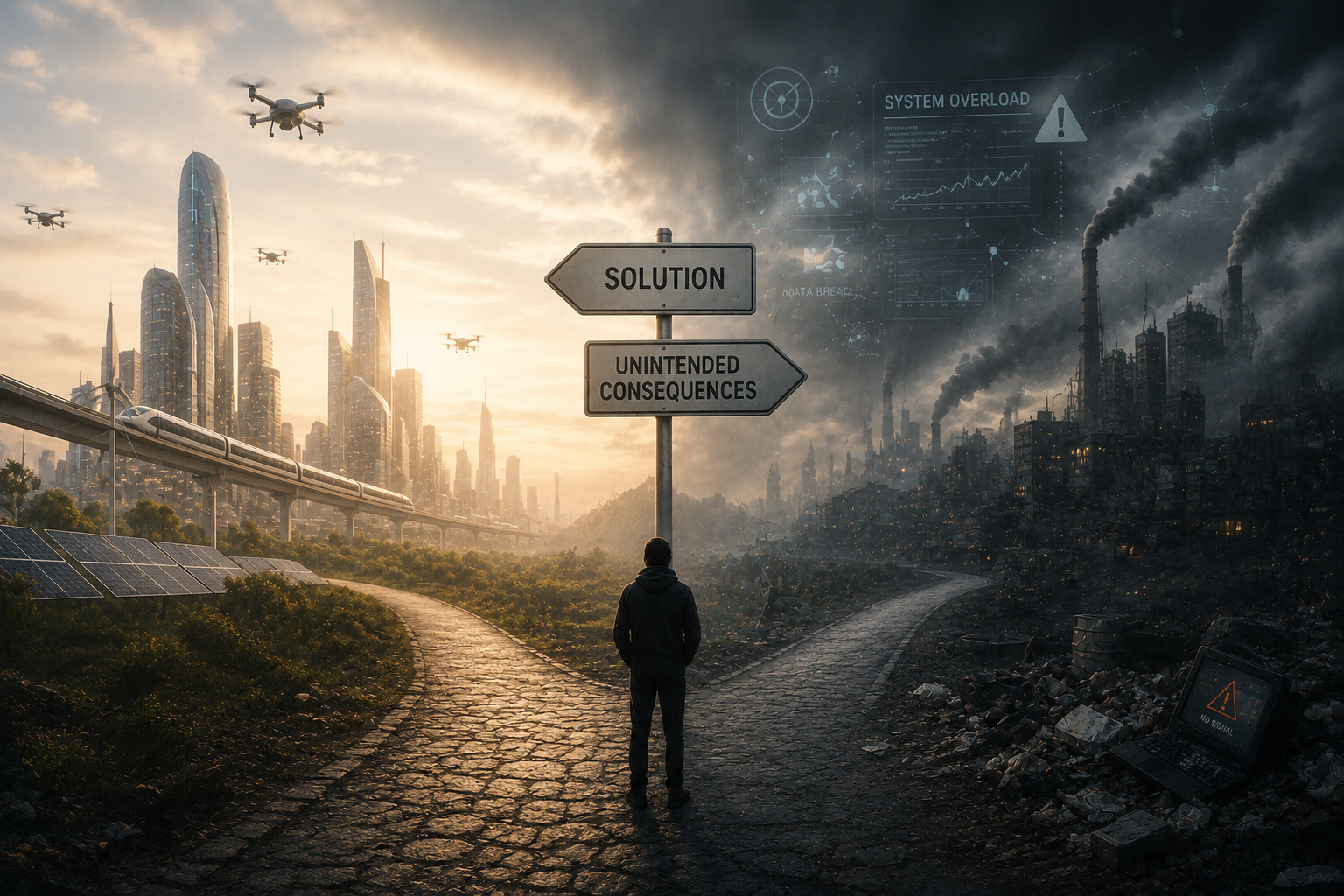
Every major technological advance seems to arrive with a problem it didn't advertise — electric cars and lithium mining, digital connection and social isolation, remote work and mental health. Elon Musk, Sherry Turkle, and Clayton Christensen examine why solutions so often generate the very complications they were meant to solve.
Key Metrics
67%
Of individuals believe technology is advancing faster than society can adapt.
53%
Of workers fear AI will displace their jobs.
72%
Of experts warn against the unregulated growth of technology.
As society races towards innovation, a pressing question arises: why does every technological advance seem to bring its own set of complications? From environmental issues linked to industrialization to social dilemmas stemming from digital connectivity, it becomes apparent that progress often creates the problems it set out to eliminate.
Context: Why This Matters Now
The COVID-19 pandemic catalyzed rapid developments in remote work technology, but also unveiled critical mental health challenges and social isolation. This juxtaposition begs deeper contemplation about innovation's unintended consequences unfolding in real-time.
Perspective: Innovation as a Driving Force
Elon Musk, CEO of Tesla and SpaceX, proposes that many solutions emerge from necessity to address a looming crisis — but often overlook long-term implications. "While we push for advancements in AI and renewable energy, we must also remain vigilant about the societal shifts they engender," Musk argues.
For Musk, the meteoric rise in electric vehicle adoption aims to mitigate climate change, yet raises concerns such as lithium mining's environmental impact and the economic ramifications for traditional auto workers — a quintessential example of one solution generating new dilemmas.
Perspective: The Human Factor
Contrasting with Musk's engineering optimism, Sherry Turkle, Professor at MIT, emphasizes the human experience at the heart of technological progress. She argues that innovation often disregards fundamental human needs, exacerbating existing problems. "As we layer technology upon technology, we risk losing our capacity for genuine conversation and connection," Turkle observes.
Her research indicates that while digital platforms offer connectivity, they can also foster feelings of loneliness and disconnection. The paradox lies in technology's promise of greater communication, which can ultimately lead to isolation.
Advertisements
Perspective: Disruption and Its Discontents
Clayton Christensen, Professor at Harvard Business School, presents a framework for understanding innovation's impact through the lens of disruption. He suggests that when a disruptive innovation is introduced, it often targets the lower tier of the market, creating opportunities while simultaneously rendering existing solutions obsolete.
"The very mechanisms that drive progress can dismantle established structures, leading to unemployment and instability," Christensen states — emphasizing that industries often fail to adapt to these shifts, resulting in both economic and social challenges.
Editorial Synthesis
Where Experts Agree
All three experts recognize that even well-intentioned innovations can lead to unforeseen negative outcomes, highlighting the complexity of societal interactions with new technologies. Musk, Turkle, and Christensen all advocate for a long-term perspective that acknowledges the broader implications of progress.
Where Experts Disagree
Turkle emphasizes the importance of encompassing human factors in innovation, whereas Musk focuses on technological impacts regardless of the human element. Christensen views disruption as a pathway to improve systems, while his colleagues express caution regarding negative repercussions on society and workforce stability.
Why This Matters
Every solution has the potential to create new dilemmas — and understanding this not only enriches the dialogue surrounding technological advancements but enables society to react proactively. Emphasizing holistic approaches to technology development — integrating human considerations and addressing systemic vulnerabilities — will be paramount to tackling the paradox of progress.
In today's context, where technological decisions are made swiftly, a measured, reflective approach to innovation could be the key to forging a more resilient future.

Editorial Take
Navigating the Double-Edged Sword of Progress
Thoughtfully CautiousWe must embrace innovation while being acutely aware of its potential downsides.
The paradox of progress challenges us to rethink our approach to innovation. While technology holds the potential to solve enormous problems, as highlighted by experts like Musk and Turkle, each advancement can also generate new challenges that we may not be equipped to handle. The juxtaposition of rapid technological growth with the emerging social and environmental ramifications demands an informed dialogue about the direction we choose. By acknowledging both the benefits and the pitfalls of innovation, we can create a more sustainable future where progress serves humanity holistically. It's not enough to simply innovate; we must innovate responsibly, keeping a keen eye on the intertwined complexities that may arise from our solutions. A concerted effort towards thoughtful implementation and foresight can help us unlock the true potential of technology while mitigating its unintended consequences.
What do you think?
Cast your vote on this debate.
References
Continue the Debate
Related topics emerging from this analysis:
The Environmental Costs of Electric Vehicles: A Deeper Look at Lithium Mining
Exploring the environmental and ethical implications of lithium mining for electric vehicles and how it contrasts with the intended benefits of reduced carbon emissions.
Balancing Innovation and Mental Health: The Challenge of a Digitally Connected World
Investigating the mental health challenges precipitated by rapid digital integration, particularly during the pandemic, and how innovation can be designed to prioritize well-being.
The Long-Term Economic Consequences of Disruptive Technologies
Analyzing the economic landscapes transformed by automation and AI, focusing on how industries and job markets must adapt to avoid exacerbating inequality.
Reassessing the Role of Human Connection in a Tech-Driven Society
Discussing the need for prioritizing human connection in technology design, examining how the digital age can reconcile the desire for innovation with the fundamental human need for community.