
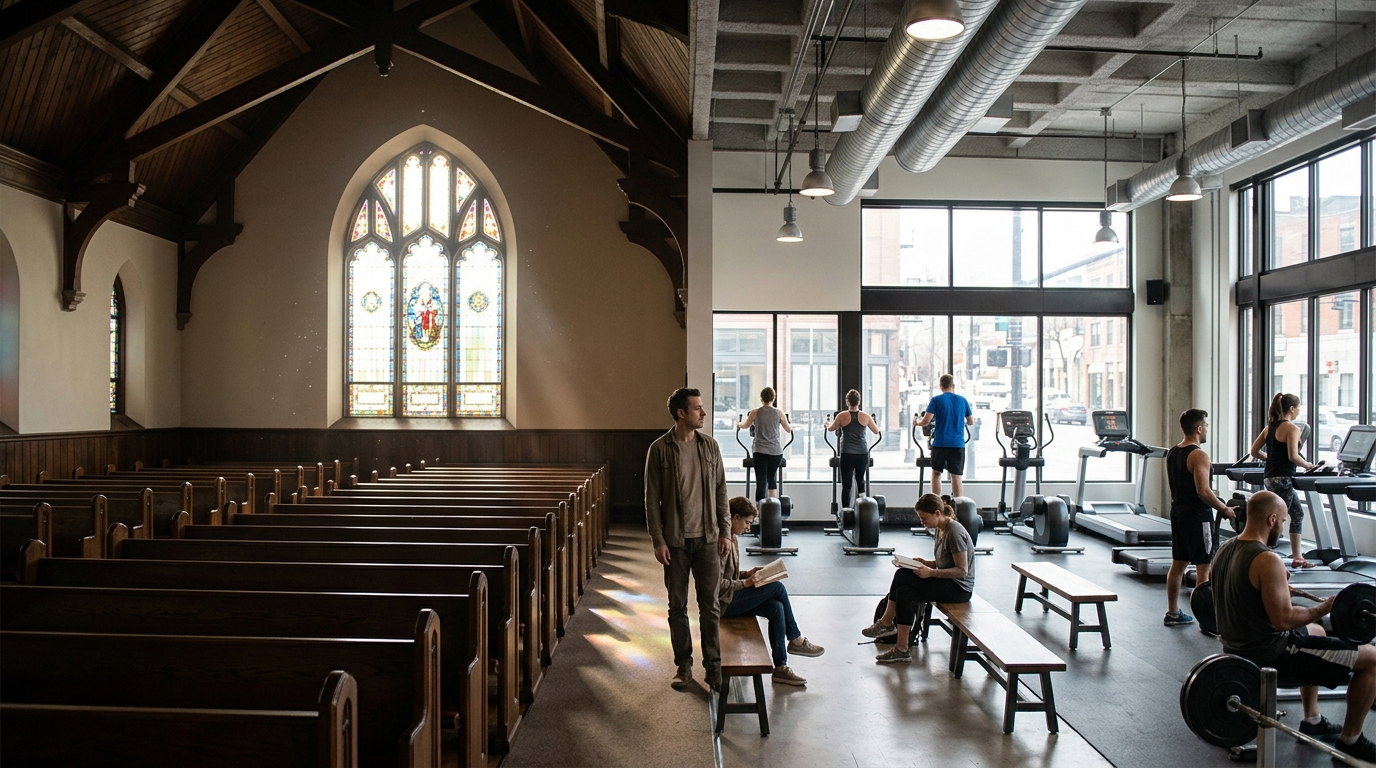
The Architecture of Sacred Space: When Churches Empty and New Temples Are Shopping Malls and Gyms, Where Do People Go to Feel Something Larger Than Themselves?
Psychedelics were once synonymous with counterculture rebellion — now Johns Hopkins has a psychedelic research center, MDMA is in FDA trials, and psilocybin is legal in Oregon. Michael Pollan, Rick Doblin, and Dr. Nora Volkow debate whether the therapeutic potential is as transformative as the early results suggest, and whether the medicalization of psychedelics will preserve or destroy what made them significant in the first place.
Key Metrics
30%
Americans identifying as non-religious
73%
People seeking community through non-traditional spaces
57%
Individuals expressing a desire for more connection in their lives
After decades of stigma and prohibition, psychedelic substances are experiencing a remarkable scientific and cultural rehabilitation — with clinical trials showing unprecedented results for depression, PTSD, addiction, and end-of-life anxiety, and a growing movement to integrate them into mainstream therapeutic practice. But as psychedelics move from the counterculture to the clinic, profound questions arise about what this transformation means for the substances themselves, the people who use them, and our understanding of mind and healing.
Context
The psychedelic research renaissance has produced some of the most striking results in recent psychiatric history. Studies at Johns Hopkins, NYU, and Imperial College London have shown that psilocybin-assisted therapy produces rapid and durable reductions in treatment-resistant depression — with effect sizes far exceeding conventional antidepressants. MDMA-assisted therapy for PTSD has shown response rates of 67-71% in Phase 3 trials, compared to 30-40% for existing treatments. Oregon has legalized supervised psilocybin use, and several cities have decriminalized psychedelics. Yet the rapid acceleration of therapeutic and commercial interest raises critical questions about safety, access, cultural appropriation, and the limits of medicalizing experiences that have traditionally been understood in spiritual, cultural, and existential rather than clinical terms.
Perspective: Michael Pollan
Michael Pollan, author of How to Change Your Mind, has been one of the most influential popularizers of the psychedelic research renaissance — bringing mainstream attention to findings that had languished in scientific obscurity for decades. "The clinical results are genuinely extraordinary," he states. "For conditions like treatment-resistant depression, end-of-life existential distress, and addiction — conditions where existing treatments often fail — the early evidence suggests that psychedelics may represent a paradigm shift in psychiatric care."
Pollan is enthusiastic about the therapeutic potential but expresses nuanced concerns about medicalization. "There is a real risk that in making psychedelics safe and respectable for mainstream culture, we strip them of the very qualities that make them powerful — the dissolution of ego, the confrontation with mortality, the experience of interconnectedness. These are not side effects to be minimized but potentially the active ingredients of healing." He worries that commercial and pharmaceutical interests may produce a sanitized version of psychedelic therapy that is more profitable than transformative.
Perspective: Rick Doblin
Rick Doblin, founder and executive director of MAPS (Multidisciplinary Association for Psychedelic Studies), has spent four decades working to bring psychedelic therapy into mainstream medicine — and represents the most optimistic voice about what medicalization can achieve. "The goal has always been to make these medicines available to everyone who needs them, not just those with access to underground therapy or the resources to travel to legal jurisdictions," he argues.
Doblin believes that working within the medical and regulatory system, despite its slow pace and compromises, is the only path to genuine scale and legitimacy. "Yes, medicalization involves constraints and trade-offs. But the alternative — leaving millions of people with untreatable PTSD, depression, and addiction without access to potentially transformative treatments — is morally unacceptable." He envisions a future where psychedelic therapy is covered by insurance, available in neighborhood clinics, and integrated into mainstream mental healthcare — a vision he acknowledges requires navigating difficult compromises but sees as worth pursuing.
Advertisements
Perspective: Dr. Nora Volkow
Dr. Nora Volkow, director of the National Institute on Drug Abuse, brings a rigorous scientific caution to the psychedelic renaissance — acknowledging the promising early results while emphasizing the significant gaps in our understanding of how these substances work, who they help, and who they might harm. "The early clinical results are genuinely exciting and warrant serious scientific investigation," she states. "But we need to be very careful about outpacing the evidence — particularly as commercial and cultural enthusiasm creates pressure for faster approval and wider availability than the science currently supports."
Volkow highlights several underexplored concerns: the potential for psychological harm in vulnerable populations, the optimal conditions for therapeutic use, the long-term effects of repeated use, and the significant risks of psychedelics outside supervised clinical settings. "The history of psychiatry is full of treatments that showed dramatic early promise and then failed at scale — or worse, caused significant harm to vulnerable patients. Rigor and caution are not obstacles to progress — they are what make progress sustainable and safe."
Editorial Synthesis
Where Experts Agree
All three experts acknowledge that the clinical evidence for psychedelic therapy is genuinely promising and represents a potentially significant advance in treating conditions where existing options are inadequate. There is consensus that psychedelics deserve serious scientific investigation and that the decades of prohibition set back potentially important research by years or decades. All agree that the conditions under which psychedelics are used matter enormously — with set, setting, and therapeutic support playing crucial roles in determining outcomes.
Where Experts Disagree
Pollan and Doblin are broadly optimistic about the therapeutic potential, while Volkow emphasizes the need for greater caution and more rigorous evidence. Pollan is most concerned about medicalization stripping psychedelics of their transformative power, while Doblin sees medicalization as the path to equity and scale. Volkow is most focused on safety and the limits of current evidence, while Pollan and Doblin are more concerned about access and the opportunity cost of excessive caution.
Why This Matters
The psychedelic renaissance raises questions that go far beyond pharmacology — touching on the nature of consciousness, the limits of materialist psychiatry, the relationship between medicine and spirituality, and the politics of who gets to define healing. If the early results hold up at scale, psychedelic therapy could represent one of the most significant advances in mental health treatment in generations — at a moment when the global mental health crisis demands exactly this kind of breakthrough.
Getting it right requires holding in tension the urgency of unmet medical need, the imperative of scientific rigor, the risk of commercial distortion, and the profound respect owed to substances and traditions that have been used for healing long before clinical trials existed — a balance that will require wisdom, humility, and genuine collaboration across disciplines, cultures, and communities.


Editorial Take
Redefining Sacred Spaces in Modern Society
Thoughtfully ProgressiveSacredness isn't lost—it can be reimagined in contemporary contexts.
As we witness the decline of traditional religious structures, it's imperative to understand that the essence of sacred space can evolve without solely relying on conventional architecture. Communities are turning to alternative environments like shopping malls and gyms, which, despite their commercial intent, offer opportunities for social bonding and shared experiences. The challenge lies in how we consciously design these spaces to foster connection and reflection. Experts like Samantha E. Smith remind us that the essence of sacredness can thrive in various forms—be it through community gardens, meditation centers, or other innovative structures that invite contemplation. The question isn't simply where we seek spiritual fulfillment, but how we can adapt our spaces to enrich these experiences, affirming that the quest for something larger than ourselves is more relevant than ever.
What do you think?
Cast your vote on this debate.
References
Continue the Debate
Related topics emerging from this analysis:
Redefining Community: The Role of Gyms as Modern Social Hubs
Explore how gyms are evolving into community centers that foster social bonds and emotional well-being, and whether this new role can fill the void left by declining religious congregations.
The Emotional Architecture of Shopping Malls: Beyond Consumerism
Investigate how shopping malls are designed to create experiences that evoke emotion and connection, and analyze whether these environments can serve a spiritual purpose.
Nature as Sanctuary: The Rise of Outdoor Spaces in Urban Life
Examine how urban parks, gardens, and nature trails are becoming the new sacred spaces that provide solace and community, contrasting with traditional religious venues.
The Future of Spirituality: Virtual Reality and New Age Sacred Experiences
Delve into how technology, particularly virtual reality, is creating immersive spiritual experiences that could redefine what it means to seek connection and meaning in the modern world.