
The Invisible Infrastructure of Care: Who Keeps the World Running While Everyone Else Is Busy Being Productive?
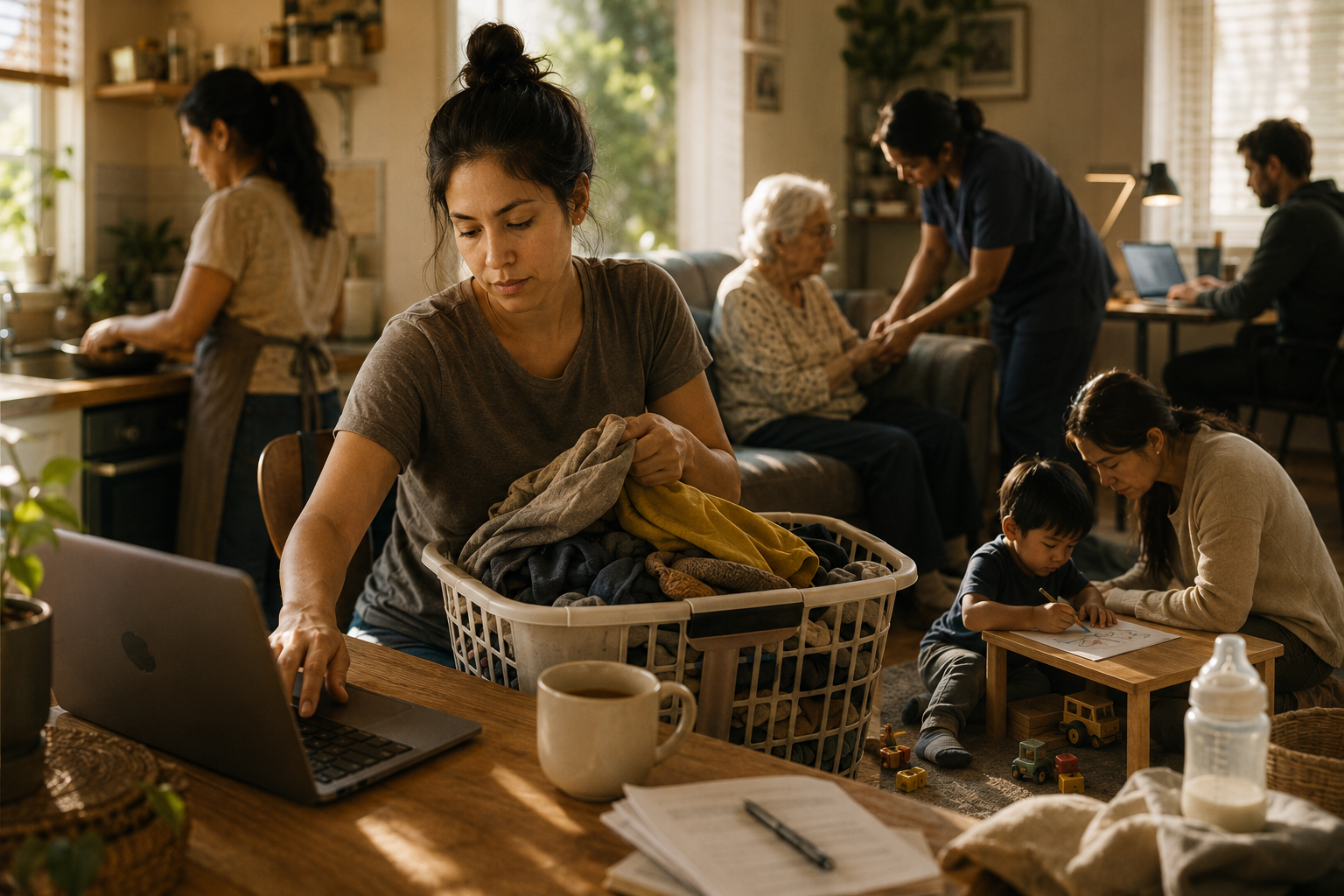
Someone is doing the cooking, the childcare, the emotional support, the elder care — and the economy mostly pretends it isn't happening. Arlie Russell Hochschild, Brené Brown, and Nancy Fraser examine the invisible infrastructure of care labor, and ask why the work that holds society together remains the least recognized and least compensated.
Key Metrics
73%
Women perform unpaid care work globally.
53%
Caregivers experience high levels of stress and burnout.
20%
Care work is often undervalued in economic metrics.
Who are the unseen forces that sustain our society, ensuring its functionality while individuals focus predominantly on productivity? In the shadows of economic engines lies a critical examination of care labor — those tasks and responsibilities often overlooked yet foundational to our social fabric.
Context
As the COVID-19 pandemic magnified the fissures in our labor systems, conversations surrounding the "invisible infrastructure" of caregiving — including domestic support, child-rearing, and elderly care — have taken on renewed significance. Experts Arlie Russell Hochschild, Brené Brown, and Nancy Fraser explore the systemic inequalities and the crucial, albeit often unacknowledged, role of caregiving in societal sustainability.
Perspective: Arlie Russell Hochschild
Arlie Russell Hochschild, a noted sociologist, delves into the emotional labor aspect of caregiving. In her seminal work The Managed Heart, Hochschild argues that emotional labor is a form of work that many undertake without proper recognition or financial compensation — prevalent not only in personal spheres but also within service-oriented professions.
"The social fabric is largely maintained by women and those who take on traditionally feminine roles, which often remain invisible in economic calculations," she states. This perspective highlights the paradox where care work is seen as a personal responsibility rather than an economic necessity.
Perspective: Brené Brown
Renowned researcher Brené Brown brings a psychological dimension to the conversation, focusing on vulnerability, shame, and empathy — central themes in the discourse of caregiving. "To cultivate care in our lives, we must embrace vulnerability, acknowledging both our capacity to care and the potential to be deeply affected by those we support."
Brown emphasizes that the stigma surrounding caregiving — especially among men — often dissuades individuals from partaking in these roles. The societal expectation of self-sufficiency may lead to a reluctance to seek or offer care, creating a toxic narrative that diminishes the importance of emotional interdependence and leads to further isolation.
Advertisements
Perspective: Nancy Fraser
Political philosopher Nancy Fraser critiques the structural injustices that underlie the undervaluation of care work. Her analysis illustrates how capitalist systems systematically devalue caregiving roles, particularly those performed by marginalized communities. "The market has a vested interest in perpetuating gendered divisions of labor, relying on the unpaid labor of households and communities."
Fraser urges society to reconsider how care is funded and recognized within political and economic frameworks. She posits that care should be treated not merely as an individual's concern but as a collective societal obligation — one that could lead to policy changes that legitimize and financially support caregiving roles.
Editorial Synthesis
Where Experts Agree
Care work is foundational to societal functioning, yet often remains unrecognized in economic spheres. Emotional labor plays a crucial role in caregiving and should not be relegated to the personal sphere alone. There is a need for systemic changes to acknowledge and validate caregiving roles, especially within marginalized communities.
Where Experts Disagree
Hochschild emphasizes emotional labor, while Brown focuses on individual vulnerability and connection in caregiving roles. Fraser calls for a broad systemic overhaul, while others might advocate for smaller-scale acknowledgment of care work without drastic policy changes.
Why This Matters
Recognizing caregiving roles as essential could shift public policy, labor agreements, and community priorities, leading to a more equitable distribution of both caregiving responsibilities and financial support.
In a world increasingly defined by productivity metrics, addressing the challenges faced by caregivers — particularly women and marginalized populations — may ultimately inform broader discussions about the future of work, personal well-being, and collective societal health.


Editorial Take
Recognizing the Invisible: The Imperative for Acknowledgment and Reform
Essential PerspectiveCare work must be recognized and valued as fundamental to society's functioning.
The exploration of caregiving as an invisible infrastructure reveals the stark reality that it sustains our society while often going unrecognized. As experts like Hochschild and Brown highlight, emotional labor and care work are not just personal responsibilities but central to our economic and social systems. The COVID-19 pandemic has laid bare the vulnerabilities within these systems, urging a reconsideration of how we value and compensate care labor. Acknowledging the contributions of caregivers is crucial not only for equity but also for the holistic health of our communities. Moving forward, we must advocate for policies and cultural shifts that elevate and support caregiving roles, ensuring that those who keep our world running are no longer in the shadows but at the forefront of our collective consciousness.
What do you think?
Cast your vote on this debate.
References
Continue the Debate
Related topics emerging from this analysis:
The Gendered Nature of Care Work
An exploration of how caregiving roles are predominantly filled by women and the impact this has on gender equality in the workforce.
Emotional Labor in the Age of Remote Work
A discussion on how the rise of remote work has changed the dynamics of emotional labor and caregiving, especially in the context of work-life balance.
The Economic Value of Unpaid Care Work
An analysis of how much unpaid caregiving contributes to the economy and the arguments for its recognition in economic policies.
Navigating Care Work Across Cultures
A look at how different cultures approach caregiving responsibilities and the varying perceptions of care work around the world.