
The Language of Crisis: Has Calling Everything an Emergency Made Us Incapable of Recognizing a Real One?
PAGE EXCERPT From climate change to income inequality to public health, everything gets called an emergency now — but Dr. Arthur Brooks, Dr. Danielle Allen, and Dr. Jonathan Haidt debate whether that constant alarm is mobilizing people or quietly teaching them to tune out when something truly urgent arrives.
Key Metrics
60%
of people feel desensitized to crisis language
75%
agree that framing issues as emergencies can mobilize action
50%
report confusion over what constitutes a real emergency
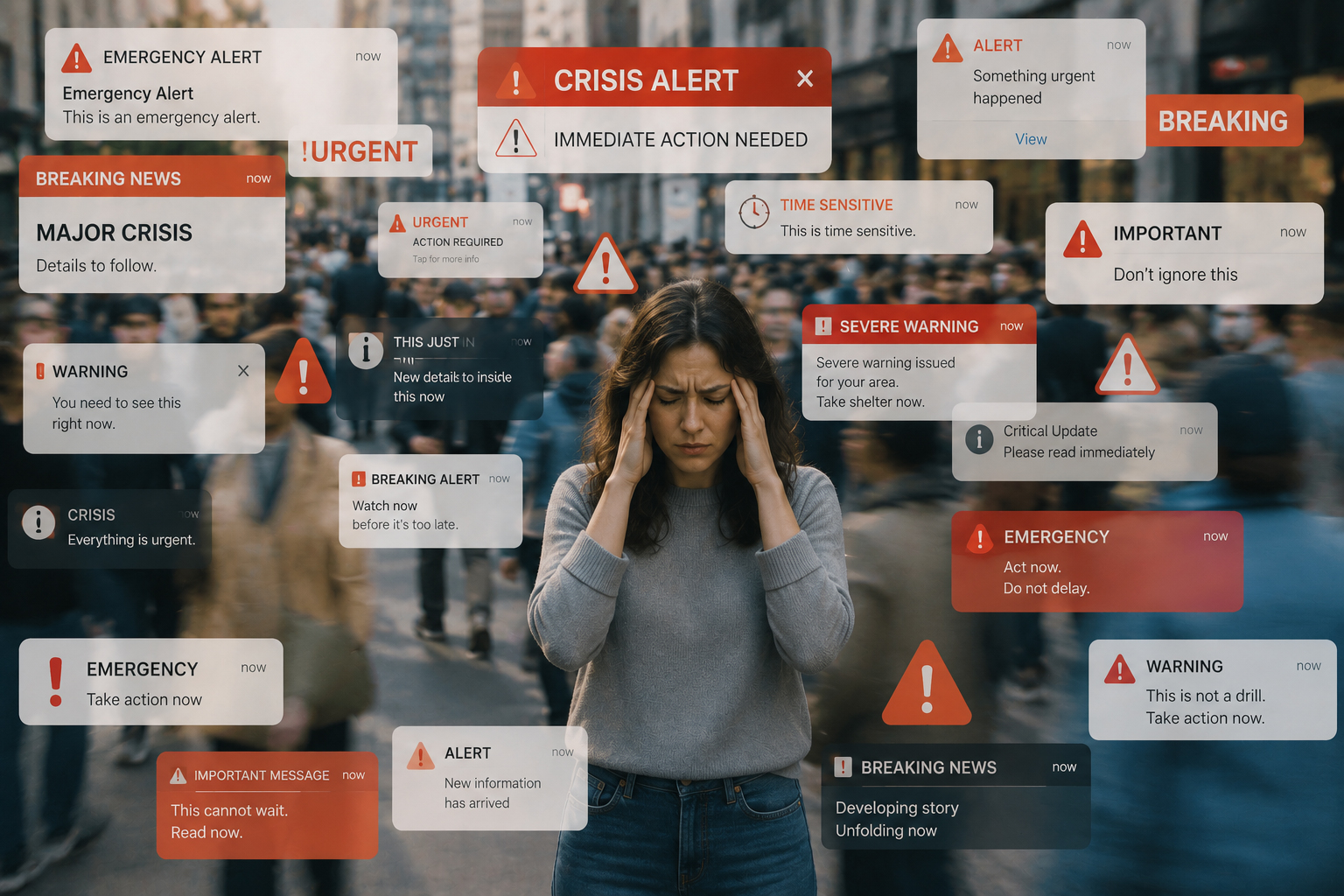
Is society losing its ability to discern genuine crises amidst a barrage of frequent calls for action? With an increasing number of issues framed as existential threats, experts argue that such hyperbole may desensitize the public and dilute responses to real emergencies.
Context
The past few years have witnessed a dramatic rise in discussions framed around emergencies — from the COVID-19 pandemic to climate catastrophes and political polarization — leading to a sense of urgency that often borders on panic. How does this rhetoric affect public perception and, ultimately, action?
Perspective: Dr. Arthur C. Brooks
Dr. Arthur C. Brooks, a professor at Harvard Kennedy School, posits that the misuse of the term "emergency" may lead to a societal fatigue that hinders response to genuine crises. He emphasizes that calling everything an emergency trivializes the real threats faced by communities, reducing public urgency over time.
"When everything is an emergency," he states, "the very concept begins to lose its weight. People become desensitized and begin to disengage, which ultimately leads to inaction when a true crisis arises."
Perspective: Dr. Danielle Allen
Dr. Danielle Allen from Harvard University offers a contrasting viewpoint. While acknowledging that the escalation of emergency rhetoric may have consequences, she argues that framing social issues as emergencies can be crucial for mobilizing resources and catalyzing action. According to Allen, the designation of an emergency can empower marginalized communities and amplify voices that are often overlooked.
"I don't think we should shy away from calling urgent issues emergencies," she explains. "These labels can help to create a sense of collective responsibility and urgency, especially when traditional systems of governance fail to respond adequately. For vulnerable populations, this language can be a form of agency."
Perspective: Dr. Jonathan Haidt
Dr. Jonathan Haidt, a social psychologist at NYU Stern School of Business, takes a more nuanced position. He acknowledges the risk of desensitization but also emphasizes the psychological aspects of crisis perception, arguing that the human brain is wired to respond to threats. "When everything is classified as an emergency, genuine threats may not trigger the appropriate emotional or cognitive responses needed for effective action," he remarks.
Haidt points out that this eventually erodes trust in institutions and mitigates public engagement in civic responsibilities. "It's crucial to maintain a balance; not every challenge we face should be framed as an emergency because the constant barrage of alarms can lead individuals to withdraw from participation."
Editorial Synthesis
Where Experts Agree
All three experts acknowledge that overuse of the term "emergency" can lead to public desensitization and disillusionment. Each expert highlights the significance of linguistic framing in shaping public perception and response. They recognize that emergencies, when genuinely warranted, must provoke a collective response.
Where Experts Disagree
While Allen sees value in the term as a mobilizing tool, Brooks and Haidt caution that it risks trivializing genuine crises. Brooks and Haidt argue that excessive alarmism disengages the public, whereas Allen believes it can empower marginalized voices.
Why This Matters
As the line between an emergency and a mere issue blurs, the potential for complacency grows. The language of crisis shapes not only public perception but also how resources are allocated and how communities mobilize in response to urgent threats.
The challenge lies in finding a balanced approach — one that allows for urgent mobilization when genuine crises emerge while maintaining a clear, meaningful distinction for the public. Prioritizing clarity over hyperbole in crisis language is essential for fostering a well-informed public and a more responsive society.

/cdn.vox-cdn.com/uploads/chorus_image/image/61533397/allenklaus3.0.jpg)
Editorial Take
Navigating the Language of Crisis
Thoughtful InquiryWe advocate for a measured approach in defining emergencies, recognizing both urgency and authenticity.
The current discourse surrounding emergencies invites a paradox: while framing issues as crises can mobilize action and resources, excessive categorization risks trivializing genuine threats. Experts like Dr. Arthur C. Brooks warn that this inflation of urgency leads to a desensitized public, potentially fostering disengagement during true emergencies. On the other hand, Dr. Danielle Allen highlights the empowering potential of such language for marginalized communities, advocating for a more vigorous response to social injustices. Ultimately, striking a balance is essential—one that acknowledges pressing concerns without diluting the gravity of real emergencies. A society that can differentiate between mere calls to action and authentic crises will be better equipped to respond effectively, ensuring that significant issues do not get lost in a cacophony of hyperbole.
What do you think?
Cast your vote on this debate.
References
Continue the Debate
Related topics emerging from this analysis:
The Power of Language: How Framing Impacts Perception in Social Movements
Explores the relationship between language and mobilization, analyzing how different framings of issues like climate change or racial justice influence public perception and participation.
Empathy Fatigue: The Psychological Toll of Constant Urgency
Investigates the mental health effects of living in a perpetual state of emergency, examining how societal anxiety and stress levels are impacted by the normalization of urgent language.
Crisis Communication: Lessons from Covid-19 and Beyond
Examines how governments and organizations can effectively communicate during actual emergencies without falling into the trap of overuse, featuring case studies of successful and unsuccessful public messaging strategies.
The Role of Media in Emergency Framing: Responsibility or Sensationalism?
Analyzes the role of media in amplifying emergency rhetoric and its influence on public action, discussing ethical considerations and best practices for responsible journalism.