
The Disappearing Third Place: When Coffee Shops, Parks, and Bars Stop Being Yours, Where Do You Belong?
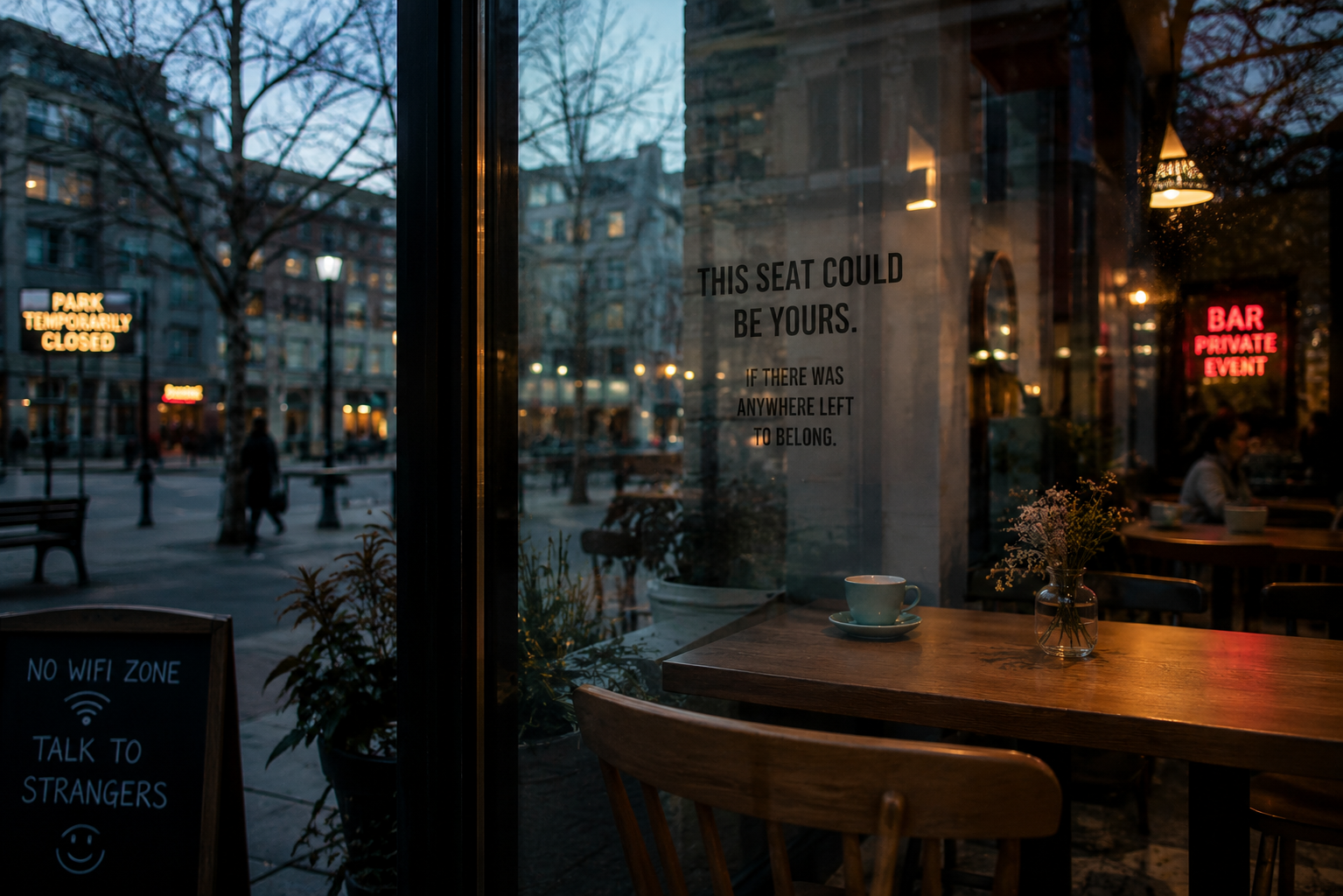
The corner café, the neighborhood bar, the public park — these "third places" between home and work are where community actually happens. But they're disappearing. Ray Oldenburg, Susan Cain, and Robert Putnam explore what we lose when the spaces that make us feel like we belong stop feeling like ours.
Key Metrics
50%
Of individuals report feeling isolated in their communities.
75%
Of people express a desire for more communal spaces in urban areas.
60%
Of third places have closed or drastically changed in the last decade.
In an increasingly digital world, the concept of the 'third place' — those communal spaces outside of home and work, such as coffee shops, parks, and bars — seems to be fading away. When these spaces no longer feel like they belong to us, where do we find our sense of community and belonging?
Context
The importance of third places has surged into public dialogue amidst increasing urbanization, digitization, and shifting social landscapes. As more people work from home and spend increasing amounts of time online, traditional gathering spaces are evolving, closing, or losing their welcoming atmosphere. The implications of these changes affect not only individual social well-being but also community cohesion.
Expert Perspectives
Perspective: Ray Oldenburg
Ray Oldenburg, author of The Great Good Place, argues that third places are pivotal for fostering community and civil society. He emphasizes that the loss of these public spaces can lead to a thinned social fabric, resulting in isolation and reduced civic engagement.
"Third places serve as anchors for community life, and their disappearance signals a retreat from shared experiences that bind people together," Oldenburg states. He believes that the biological need for social interaction is at stake when third places vanish, making it vital to advocate for public spaces that welcome everyone.
Perspective: Susan Cain
Susan Cain, co-founder of Quiet Revolution and author of Quiet, explores the psychological implications of lost third places, particularly for introverts. She notes that many introverts seek refuge in coffee shops and libraries, finding comfort in public solitude that energizes them.
"When these spaces no longer feel like they belong to us, it impacts not only introverts but also the broader community. We lose opportunities for meaningful connection and quiet reflection," Cain asserts. She emphasizes that such spaces should cater to diverse needs, allowing people to feel at home.
Advertisements
Perspective: Robert Putnam
Robert Putnam, political scientist and author of Bowling Alone, provides a quantitative lens on the issue, pointing toward the empirical decline in community engagement and social trust. He identifies third places as fundamental to social capital, which he argues is essential for a thriving democracy.
"The decline of third places corresponds with a decrease in social trust and civic engagement," Putnam observes. He warns that when individuals lack a sense of belonging, they are less likely to participate in democratic processes, leading to a problematic decline in public life.
Editorial Synthesis
Where Experts Agree
The loss of third places has detrimental effects on community cohesion and individual social well-being. Third places facilitate important interactions that bolster civic engagement and social capital. A diverse range of spaces should be available to cater to various social needs, including those of introverts and extroverts alike.
Where Experts Disagree
The severity of the impact is interpreted differently — Oldenburg and Cain focus on individual psychological effects, while Putnam emphasizes broader societal risks. Solutions also vary: Oldenburg calls for the creation of more public spaces, Cain promotes more inclusive designs in existing spaces, and Putnam suggests addressing systemic conditions to rebuild social capital.
Why This Matters
The conversation around the disappearing third place is not just an academic discussion; it touches upon the fabric of society itself. As individuals seek belonging amidst an ever-changing landscape, the value placed on shared spaces becomes more critical. When communal spaces are relegated to the background, society risks losing vital connections, engagement, and a sense of identity.
Ultimately, fostering new forms of third places or revitalizing existing ones is essential to ensure that people feel they belong in their communities. As cities grapple with these issues, public discourse and action must prioritize the preservation and creation of spaces where everyone can come together to forge meaningful relationships.

Editorial Take
Reclaiming Our Third Places
ProactiveWe must actively work to reclaim and nurture our shared spaces.
The fading of third places such as coffee shops, parks, and bars underscores a pressing need for community engagement and re-imagination of our shared spaces. As Ray Oldenburg highlights, these venues are foundational for sociability, and their decline threatens the essence of community life. Furthermore, as Susan Cain points out, the loss of welcoming spaces impacts even the quieter among us, stifling both reflection and conversation. To combat these trends, we must advocate for the creation and preservation of inclusive environments that cater to diverse needs. By doing so, we can re-establish a sense of belonging in our communities, ensuring that no one is left behind in the rush towards a digital existence. Embracing and revitalizing our third places isn't just beneficial for individuals; it’s essential for the fabric of society itself.
What do you think?
Cast your vote on this debate.
References
Continue the Debate
Related topics emerging from this analysis:
Digital Third Places: Are Online Communities the Future?
Exploring how virtual spaces, like social media and online forums, can fulfill the role of third places in a digital age and their impact on social well-being.
Reimagining Urban Spaces: Designing Welcoming Third Places
Investigating how urban planners and designers can create inclusive and inviting third places that cater to diverse communities and encourage social interaction.
The Role of Third Places in Mental Health
Analyzing the psychological benefits of third places for mental health, focusing on how access to communal spaces can alleviate feelings of loneliness and isolation.
The Decline of Third Places: A Generational Shift?
Examining whether younger generations have different expectations and needs for communal spaces and how these preferences influence the evolution of third places.