
Are Universities Becoming Obsolete?
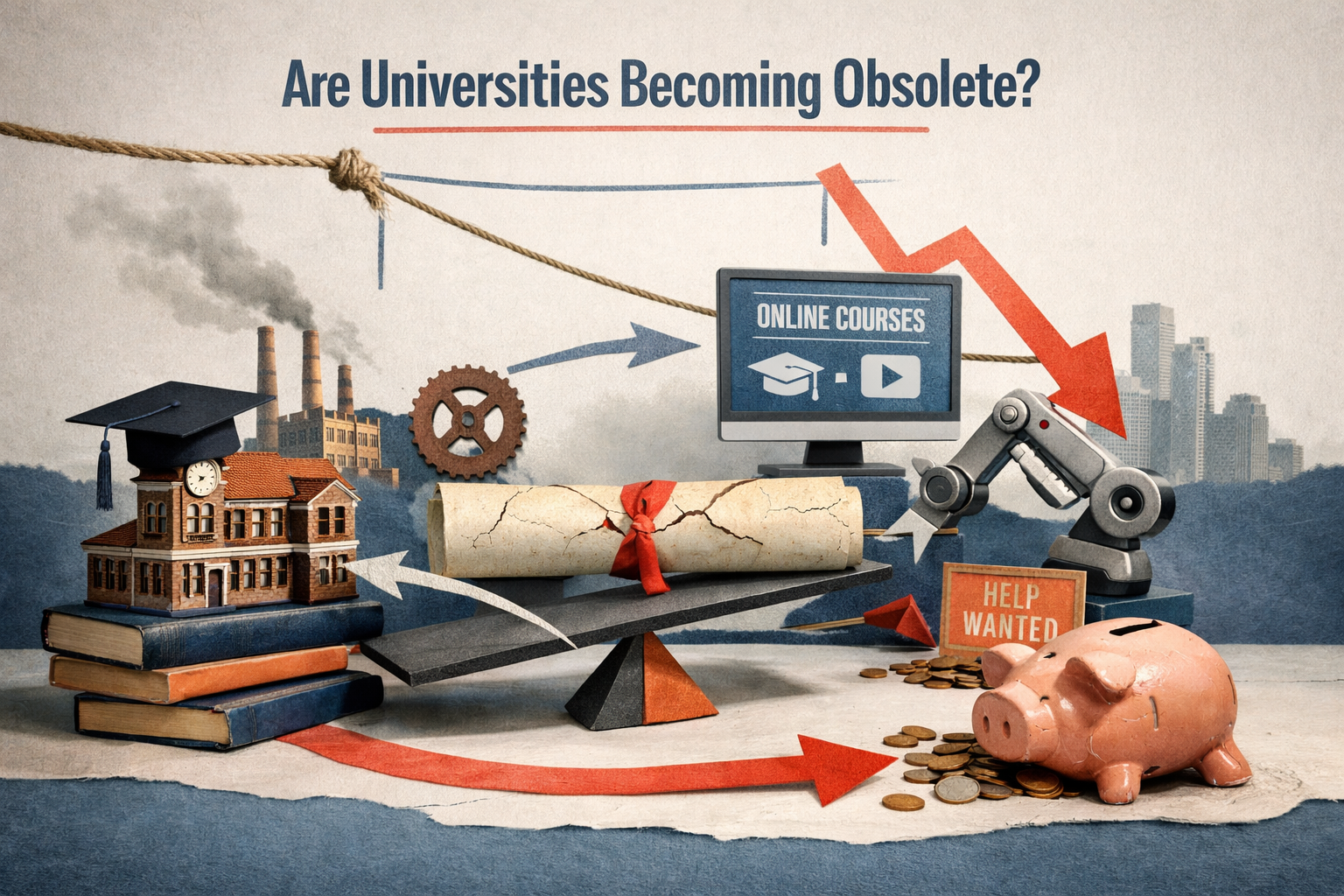
FEATURED ANALYSIS Are Universities Becoming Obsolete? Is the traditional university model fading in the face of modern educational alternatives? As we...
FEATURED ANALYSIS
Are Universities Becoming Obsolete?
Is the traditional university model fading in the face of modern educational alternatives?
As we move toward 2026, the landscape of higher education is undergoing rapid transformation. With the proliferation of online courses, AI technologies, and shifting perceptions of value, the question arises: are universities becoming obsolete? This analysis delves into the insights of various experts on this critical topic.
Perspective: The Decline of Traditional Education Value
The financial burden of obtaining a degree is becoming increasingly relevant. Scott Galloway argues that the cost of higher education often outweighs its benefits, with graduates facing student debt that can take decades to repay. Furthermore, the perceived value of a university degree is declining as employers begin to prioritize skills over diplomas. Galloway notes, "Universities are increasingly seen as institutions that excel in social signaling, not in imparting necessary skills or knowledge."
David Brooks emphasizes that societal expectations have shifted; once viewed as essential, a university degree now comes with skepticism from both students and parents. The rise of alternative education pathways, including coding bootcamps and online certifications, challenges the historical dominance of universities. In a world where information is more accessible and learning can occur outside of traditional classrooms, the role of universities is indeed being questioned.
Perspective: The Shift Toward Online Education
As technology evolves, so do the methods of teaching and learning. Anant Agarwal points out that online education platforms like edX are providing people with opportunities to acquire new skills without the constraints of physical classrooms. This democratization of education allows individuals around the world to access high-quality learning materials for a fraction of the cost.
Advertisements
Katherine Mangu-Ward further elaborates on this shift, noting that online modalities can cater to a diverse range of learners, ensuring education is more inclusive. The COVID-19 pandemic has accelerated this shift, demonstrating that effective online learning can replace traditional models and reach a much wider audience.
Perspective: Technological Disruption and Its Impacts
Peter Thiel argues that the educational system is ripe for disruption. He believes that innovative technologies, such as artificial intelligence, are becoming integral to learning and assessment. AI can provide personalized learning experiences and streamline the educational process, reducing the necessity of traditional university structures.
However, this potential disruption is met with caution. Critics warn that while technology enhances learning, it may also create disparities in access and quality. As universities grapple with integrating these technologies while maintaining their relevance, the debate about their future becomes even more contentious.
Editorial synthesis
Where experts agree
- The traditional university model faces increasing scrutiny.
- Cost and student debt influence perceptions of university value.
- Online education is gaining traction as a viable alternative.
- Technological advancements are reshaping learning methodologies.
Where experts disagree
- The extent to which universities will adapt to changes.
- Whether online education can truly replace university experiences.
- The long-term societal implications of valuing skills over degrees.
- The quality of education provided by traditional versus online formats.
Why this matters
Understanding the evolving role of universities is crucial not only for prospective students but also for policymakers, employers, and society at large. The implications extend beyond education to economic stability and workforce development, making this a pivotal conversation in the coming years.
Textuno's Take on this debate
This discourse on the relevance of universities prompts us to reconsider the very notion of education in today’s world. As alternative pathways emerge, we must evaluate what it means to be educated in an evolving landscape.
-> Read Textuno's Take
-> Explore the Deep Dive
Voices Referenced

Professor, NYU Stern

Columnist, The New York Times

Editor-in-Chief, Reason

Entrepreneur, Investor

CEO, edX
What do you think?
Cast your vote on this debate.